


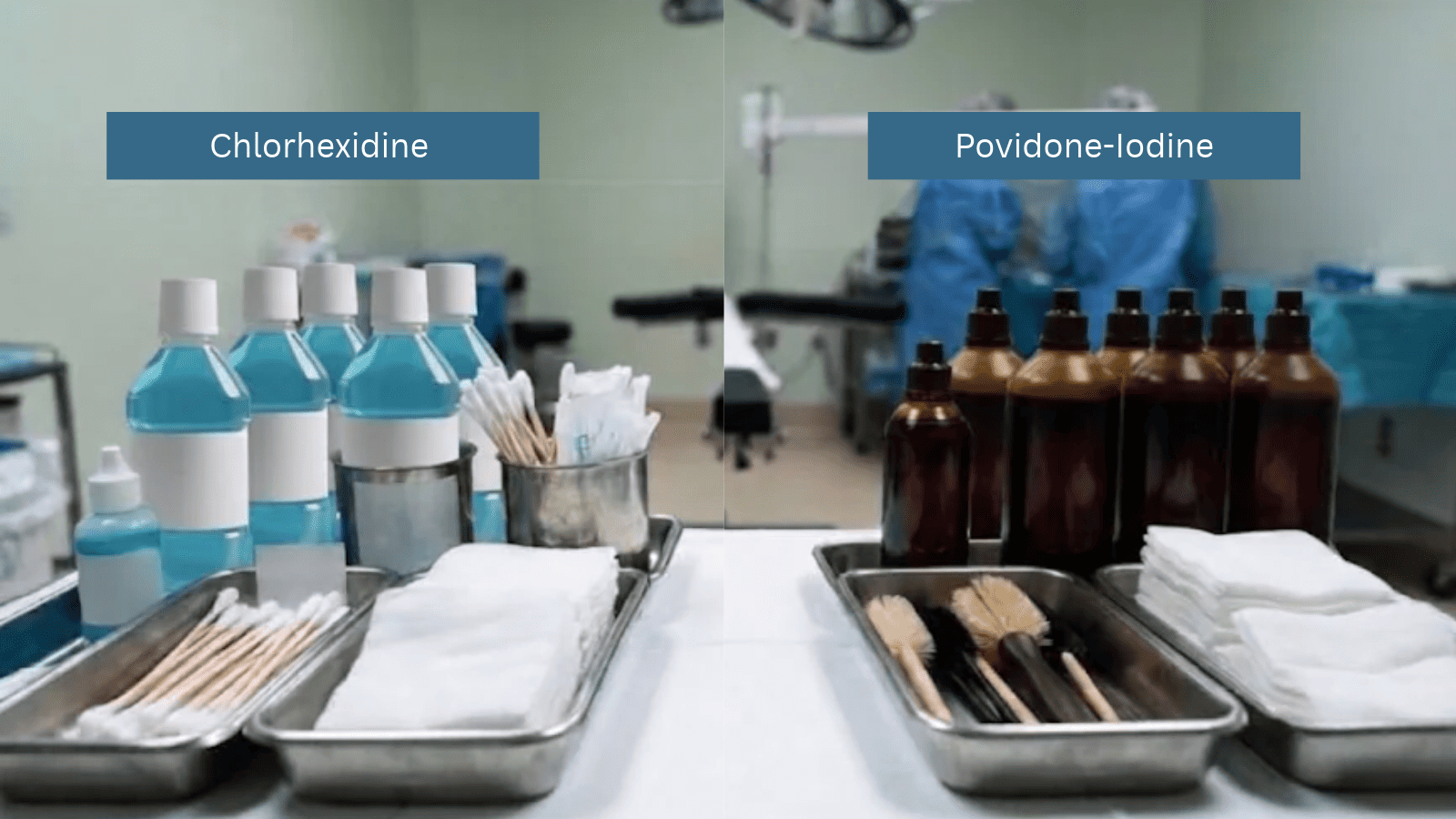
A 2026 systematic review and meta-analysis involving nearly 30,000 patients provides compelling evidence supporting chlorhexidine over povidone-iodine for preoperative surgical skin antisepsis.
Preventing surgical site infections (SSIs) remains a major challenge in healthcare. Although chlorhexidine and povidone-iodine are widely used antiseptics, their comparative effectiveness has been debated for years.
The researchers analysed 26 randomized controlled trials involving 29,356 surgical patients.
The overall surgical site infection rate was:
Chlorhexidine achieved an 11% relative reduction in surgical site infections, a statistically significant advantage (RR 0.89; 95% CI 0.80–0.99; p = 0.03).
Although the absolute reduction was modest at 0.7 percentage points, even small improvements in infection prevention can become meaningful when applied across large numbers of surgical procedures.
One particularly important finding concerned superficial surgical site infections.
Across 13 randomized trials involving 16,867 patients, chlorhexidine reduced the relative risk of superficial infections by 23% compared with povidone-iodine (p = 0.004).
This finding is especially relevant because microorganisms present on the skin can contribute to postoperative wound infections.
Chlorhexidine disrupts bacterial cell membranes, affecting their integrity and function.
Importantly, chlorhexidine can also provide residual antimicrobial activity on the skin, continuing to suppress bacterial growth after application.
This sustained activity offers a plausible biological explanation for its superior performance, although the meta-analysis did not directly test this mechanism.
The evidence supports chlorhexidine-based preparations as an effective choice for preoperative skin antisepsis.
However, the analysis did not demonstrate significant superiority for deep or organ-space infections. Differences in antiseptic formulations, including alcohol content, must also be considered.
For dental professionals, these findings are relevant to infection prevention principles but should not automatically be extended to intraoral antisepsis or implant surgery.
Chlorhexidine demonstrated statistically significant superiority over povidone-iodine in preventing overall and superficial surgical site infections.
The clinical advantage is modest but meaningful, reinforcing the importance of selecting antiseptics based on comparative evidence rather than convention alone.
Wang L, Xu S, Xu Q, Xiao J. Comparing the efficacy of chlorhexidine and povidone-iodine for surgical site disinfection: a systematic review and meta-analysis from randomized controlled trials. Annals of Medicine. 2026.
| PRODUCTS | QTY | PRICE | VALUE in INR |
|---|
| PRODUCTS | QTY | PRICE | VALUE in INR |
|---|