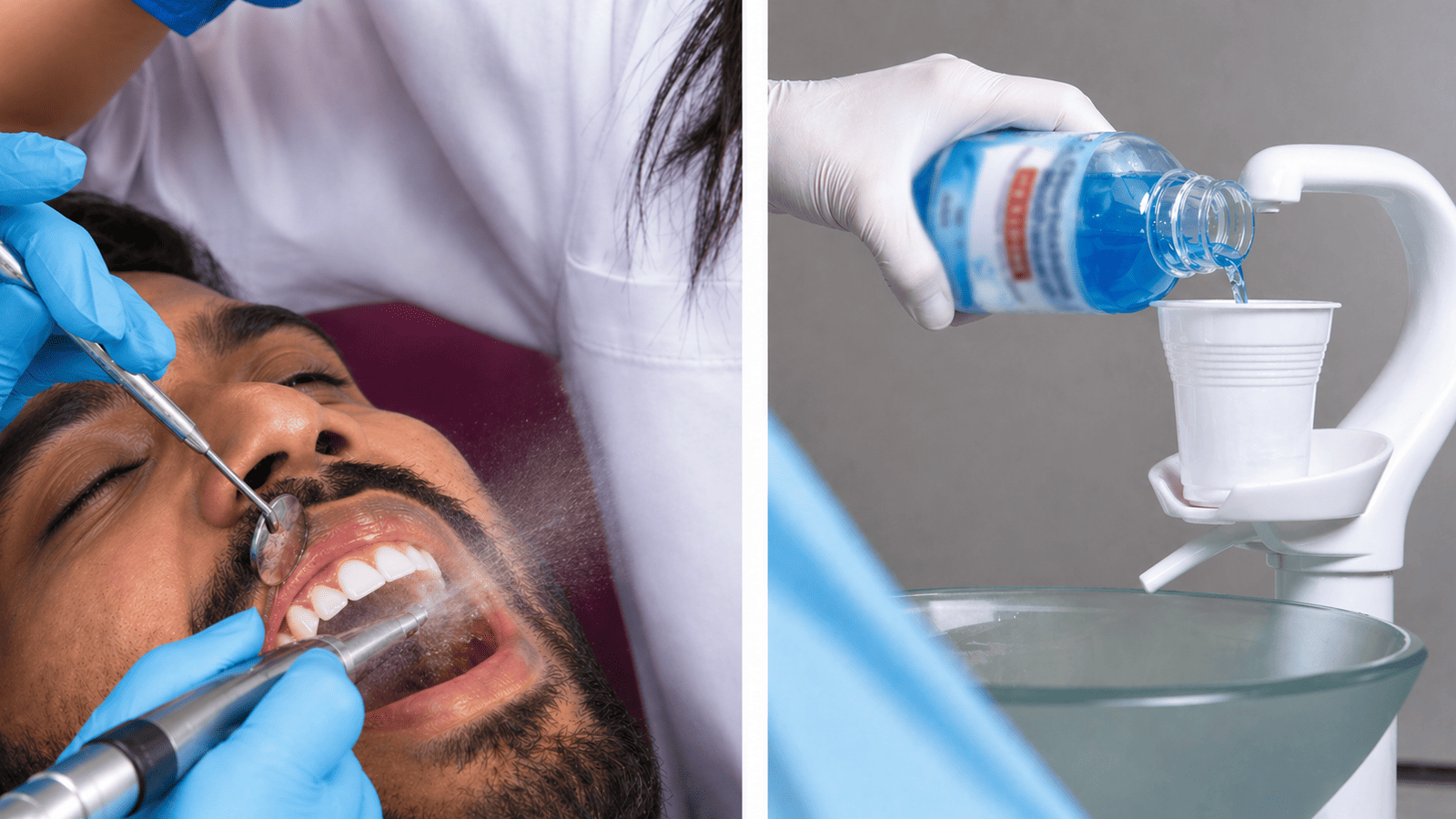
Preprocedural mouthwashes are used to reduce microbial load in aerosols generated during dental procedures. A recent network meta-analysis (Int Dent Hyg, 2026) compared the efficacy of commonly used mouthwashes and ranked them based on available evidence.
Other agents showed moderate effects. Cetylpyridinium chloride (CPC) ranked
second (SUCRA 0.68), although the direct evidence supporting it was limited.
Herbal mouthwashes demonstrated a notable reduction (SMD −5.16, 95% CI
−8.04 to −2.17) and ranked third (SUCRA 0.61). Povidone-iodine (PVP-I) also
reduced microbial load (SMD −4.57, 95% CI −8.79 to −0.21), with a SUCRA of
0.53.
Essential oil mouthwashes, normal saline, and hydrogen peroxide showed lower
efficacy, with SUCRA values below 0.45. The control group had minimal effect
(SUCRA 0.03).
From a clinical perspective, CHX remains the most effective option for reducing
bacterial aerosols during procedures. CPC and herbal formulations may be considered in patients with CHX intolerance or mucosal sensitivity. PVP-I is
another alternative, though with variable effect estimates.
The overall certainty of evidence across comparisons was low, and
heterogeneity between studies was present. Most studies focused on bacterial
aerosols, with limited data on viral reduction.
Current evidence supports the use of CHX as a preprocedural rinse, while
highlighting the need for further well-designed trials, particularly for viral
outcomes and standardized protocols.
Reference:
Zhou Q, Hong F, Xiao Y, Lin Y, Li E, Yu X. Comparative efficacy of
preprocedural mouthwashes in reducing microbial aerosols during dental
procedures: A network meta-analysis. Infect Dis Health. 2026 Apr
19;31(3):100426. doi: 10.1016/j.idh.2026.100426. Epub ahead of print. PMID:
42008926.