


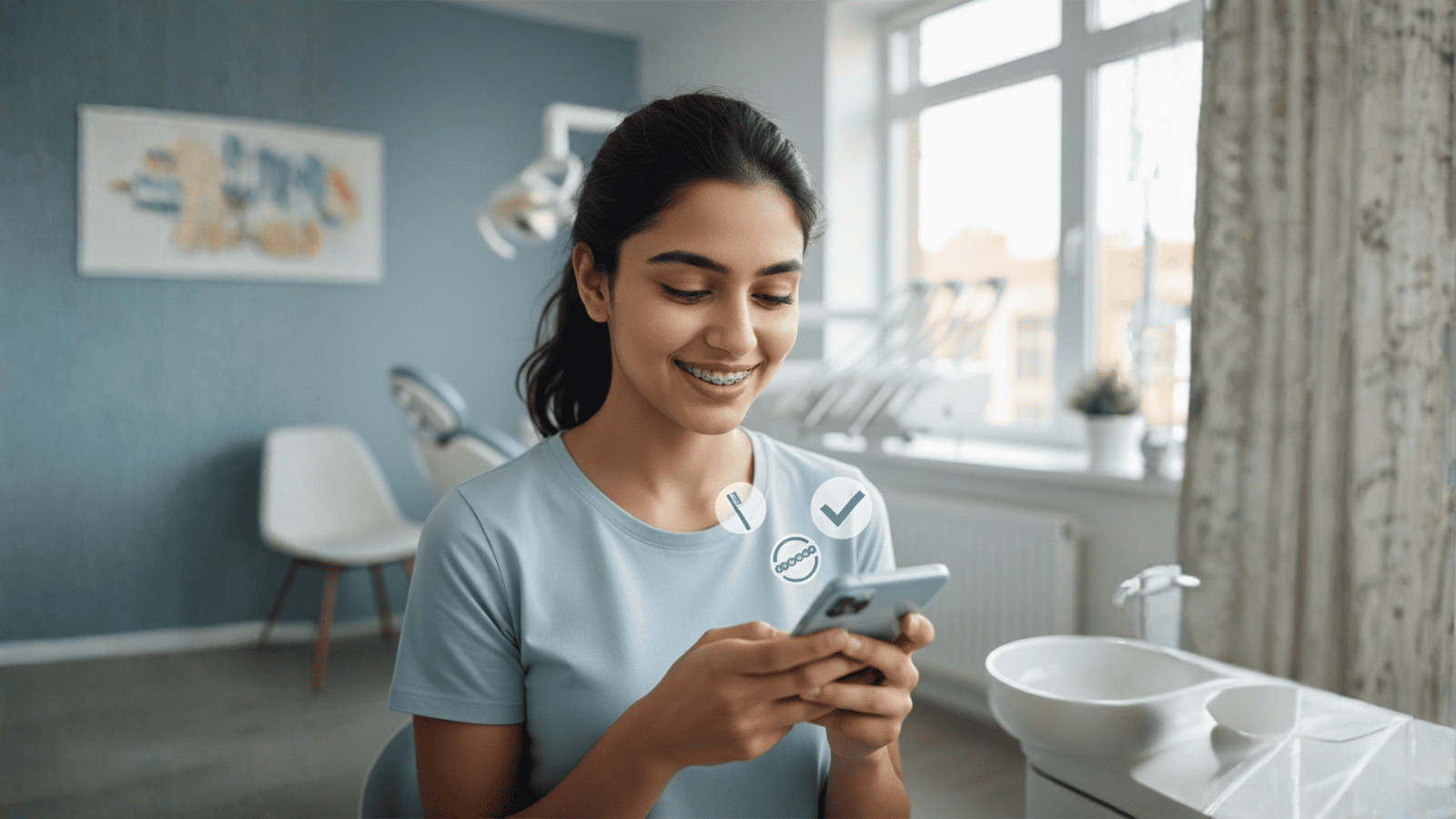
The most frustrating day in an orthodontist’s life isn’t a broken bracket or a lost retainer—it is the day of debonding. You remove the appliance to reveal perfectly aligned teeth, only to find them framed by inflamed gingiva and white spot lesions.
We all give the standard “ortho instructions” on bonding day. We hand out the kit. We demonstrate the interdental brush. Yet, hygiene often deteriorates as the excitement of new braces fades into the routine of daily life.
A new 2025 Randomized Controlled Trial published in BMC Oral Health explains why this happens and offers a modern solution. The problem isn’t that patients don’t know how to brush; it’s that our instructions are episodic (once every 4-6 weeks), while their habits are daily.
The solution? Social Media Instructions.
The study tracked 44 adolescent patients undergoing fixed orthodontic treatment. They were divided into two groups:
The results exposed a flaw in the traditional approach:
The most critical finding for clinicians wasn’t just that social media instructions worked—it was when they worked.
For the first two months (T1 and T2), there was no significant difference between the groups. Both groups struggled equally. However, at the 3-month mark (T3), the data diverged sharply. The social media group began to show significantly lower GI and Plaque scores, a trend that continued to improve through month 6.
Why 3 months?The authors correlate this with social psychology research suggesting it takes approximately 66 days (2-3 months) for a new behavior to solidify into a habit.
Clinical Takeaway: Your hygiene interventions (whether digital or in-person) require persistence. If you don’t see results in week 4, do not stop. You are fighting through the “habit lag.”
You do not need to be a social media influencer to get these clinical results. The study used a simple, reproducible protocol that any practice can mimic:
The Content:
We operate in a 6-week cycle of appointments, but our patients operate in a 24-hour cycle of digital consumption.
Relying on a lecture given weeks ago is a losing strategy. By integrating consistent social media instructions—simple, twice-weekly reminders—you can extend your clinical presence into the patient’s daily life. This study proves that while you can’t be in their bathroom every night to supervise brushing, appearing in their feed is a clinically effective alternative.
| PRODUCTS | QTY | PRICE | VALUE in INR |
|---|
| PRODUCTS | QTY | PRICE | VALUE in INR |
|---|